OPERATING DESIGN · PRODUCT JUDGMENT · AI-ASSISTED WORKFLOWS

I build the system,
then change it when
it meets reality.

I learned execution in transactions, then became the first dedicated M&A hire at a Blackstone-backed company and built the operating process around the work.

Since then, I have applied the same habit to AI-assisted workflows and products I build and test myself: make the problem concrete, build a first version, use it, and change what reality proves wrong.

30+Acquisition Opportunities Evaluated
6Functions Coordinated in Cross-Functional Diligence
2Product Concepts Taken From Problem Framing to a Built Prototype
20+Investment Memos

OPERATING DESIGN

From no playbook to a process people would actually use

When I joined a Blackstone-backed healthcare services company as its first dedicated M&A hire, there were acquisition priorities but no dedicated operating cadence.

Every opportunity still had to move through the same questions:

  • Is it strategically relevant?
  • What do we actually know?
  • What is missing?
  • Who owns the next answer?

I built the intake, screening, investment memo, diligence, reporting, and integration-planning process, then ran it across more than 30 acquisition opportunities.

THE ITERATION

The first version was not the right one.

BEFORE

Broad requests. Distributed ownership.

Diligence relied too heavily on broad feedback requests sent to busy functional teams working across time zones.

Ownership was not always obvious. Findings lived across threads. Follow-up became another workstream.

AFTER

A visible decision path.

I moved the process toward function-specific review folders and structured Key Diligence Findings templates.

Each team could see what it owned, what it needed to review, which questions remained open, and what happened next.

The process became easier to run because the decision path became easier to see.

WHERE AI FIT

A shorter path from question to reviewable work.

Alongside the operating process, I developed a repeatable AI-assisted approach to first-draft research and synthesis.

FrameStructureGenerateVerifyJudgeCommunicate

Before anything informed a decision, I reviewed it against three gates:

Source accuracyStrategic relevanceCompleteness

AI shortened the distance between a question and something concrete enough to review. It did not replace the judgment required to rely on the answer.

Problem framingWorkflow designStakeholder alignmentDecision gatesIteration

DELIVERY UNDER PRESSURE

Working inside a process that could not slip

Royal Paper's $180M+ sale to Sofidel America ran through a Chapter 11 Section 363 court-supervised process.

The deadlines were fixed. The dependencies were real.

As a deal team analyst, I supported the process across financial and operating analysis, transaction materials, buyer outreach, diligence, process management, and execution, and assumed primary execution responsibility after a mid-process staffing change on the deal team.

The work required a constant view of what had to happen next, who owned it, which workstream was waiting on which piece of information, and what needed escalation before it became a blocker.

A process like that does not stay clean because the plan was good on day one. New information keeps arriving. Priorities move. People become constrained. Dependencies change.

The job is to keep the critical path visible anyway.
View public transaction ↗
01Owners
02Dependencies
03Critical path
04Escalation
05External stakeholders
06Fixed deadlines

BUILDING AND PRODUCT JUDGMENT

I build to learn what the problem actually requires.

The same pattern shows up in my independent product work: make the assumptions explicit, build enough to challenge them, and keep a visible distinction between what exists and what still needs evidence.

NORTHSTAR · PERSONAL OPERATING SYSTEM

Northstar

I lived the workflow before I designed the product.

Northstar did not start as an app idea.

I was managing a job search, product work, learning, and several competing commitments at once. I began using AI conversationally as a personal operating layer: plan the day, force priority tradeoffs, adapt when reality changed, close the day against what actually happened, and synthesize the week before planning the next one.

Over time, repeated use exposed rules that were useful enough to formalize.

What should remain a conversation, what deserves a dedicated interface, and which of these behaviors are useful beyond the way I personally work?
HOW NORTHSTAR EVOLVED

Dogfooding came first. The interface came later.

01 · LIVERun the operating system against real days and real constraints.
02 · OBSERVENotice recurring failure modes, tradeoffs, and behaviors.
03 · FORMALIZETurn repeated patterns into explicit planning and evidence rules.
04 · PROTOTYPETranslate the workflow into dedicated product surfaces.
05 · VALIDATEUse customer interviews to separate founder preference from broader user need.
PRODUCT THESIS

How do you connect long-term direction with what someone actually chooses to do this week and today?

People can say what matters to them, but their actual allocation of time and attention may tell a different story. Northstar explores whether planning, execution evidence, reflection, and adaptation can become one useful feedback loop.

DirectionLife AreaWeekly CommitmentDaily PriorityScheduleEvidenceReflectionAdaptation
WHAT I WAS ACTUALLY TESTING ON MYSELF

Planning behavior, not a longer task list.

01
Prioritization

Not every important task can be P0. P0 must materially change the day or week, P1 is important, and P2 is maintenance or flexible. The useful behavior is accepting the tradeoff.

P0 · P1 · P2
02
Capacity and scheduling

A plan is credible only when it competes for actual time. Fixed commitments stay fixed, flexible work can move, and the system replans from now when the day changes.

Capacity · Dependencies · Replanning
03
Evidence over intention

Completion is based on what actually happened. Daily review captures completed work, deviations, blockers, actual time, and decisions so the next plan starts from evidence.

Plan vs actual · Evidence
04
Weekly adaptation

A weekly recap should not repeat seven daily summaries. It should decide what continues, what stops, what changes, and what deserves another week.

Retrospective · Adaptation
AI IN THE LIVE WORKFLOW

AI was part of the operating system before it was part of the interface.

I have used AI throughout the live workflow to structure priorities, challenge overloaded plans, replan around changing constraints, synthesize daily evidence, identify patterns across weekly reviews, and carry forward useful operating context.

The hard part is not adding a chat window. It is deciding what becomes persistent context, what is observation versus inference, what the system may suggest, what requires confirmation, what is not evidence, and where human judgment remains final.

AI should help people live their lives, not live their lives for them.
The conversational workflow is where I have been actively using AI. The interface prototype specifies how those behaviors could be represented in software. Its model connection is intentionally disabled.
PRODUCT PRINCIPLE

Orchestration is different from expertise.

Northstar can support universal planning problems such as priority, capacity, sequencing, tradeoffs, overload, and replanning. That does not make it an authority in every life domain.

PRODUCT PRINCIPLE

Direction is not something a questionnaire should declare.

For uncertain choices, form a working hypothesis, run small real-world experiments, observe interest, effort, energy, feedback, and behavior, then update the hypothesis. Direction should evolve from evidence in action.
STRATEGIC RESET

I also changed the development process itself.

The initial research plan became too broad. I stopped treating research completeness as progress and reset the sequence to:

Strategy → Focused Research → Prototype → Real Usage → Build

The rule became simple: research a question when the answer could change a product decision. The daily planning layer is still a hypothesis, not a sacred feature.

CUSTOMER DISCOVERY

Dogfooding is useful and dangerous as product evidence.

The current version is deliberately shaped around how I work. Customer interviews are separating three things:

Real recurring user problem · Personal preference · What existing tools already solve well enough

They are testing generalizability, not proving demand, willingness to pay, retention, or product-market fit.

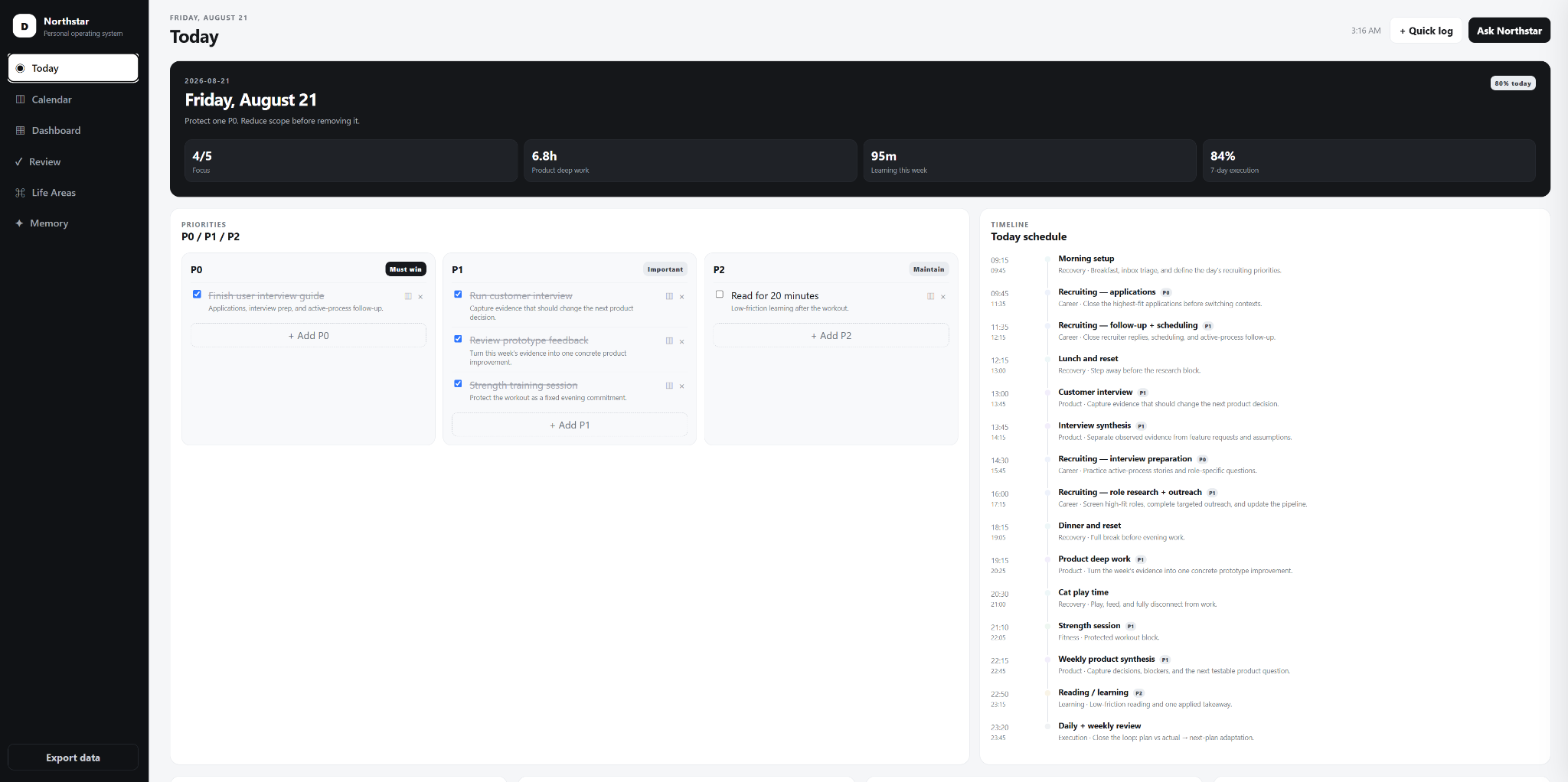
TODAY

What deserves today?

Priority and time are one decision, not two. P0, P1, and P2 sit next to the schedule that must actually absorb them. The goal is a realistic allocation decision under limited capacity.

Prioritization · Capacity · Sequencing · Time allocation
Northstar Today prototype showing priorities beside a daily schedule
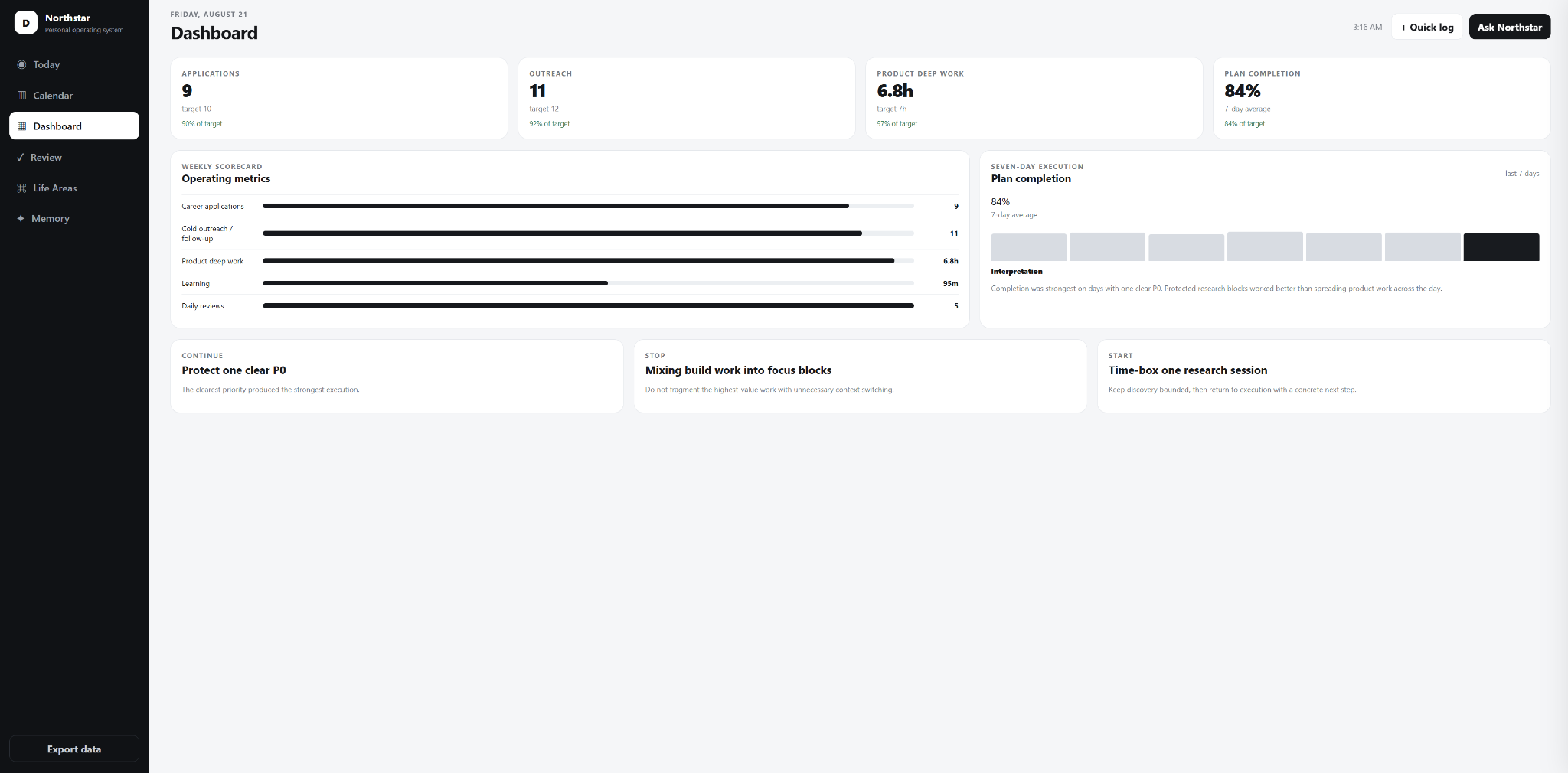
DASHBOARD

What did reality teach us?

A review should change the next plan, not just score the last one. The weekly view compares intent with execution, surfaces recurring patterns, and turns them into Continue, Stop, and Start decisions.

Plan vs actual · Retrospective · Pattern detection · Adaptation
Northstar Dashboard prototype showing operating metrics and weekly plan completion
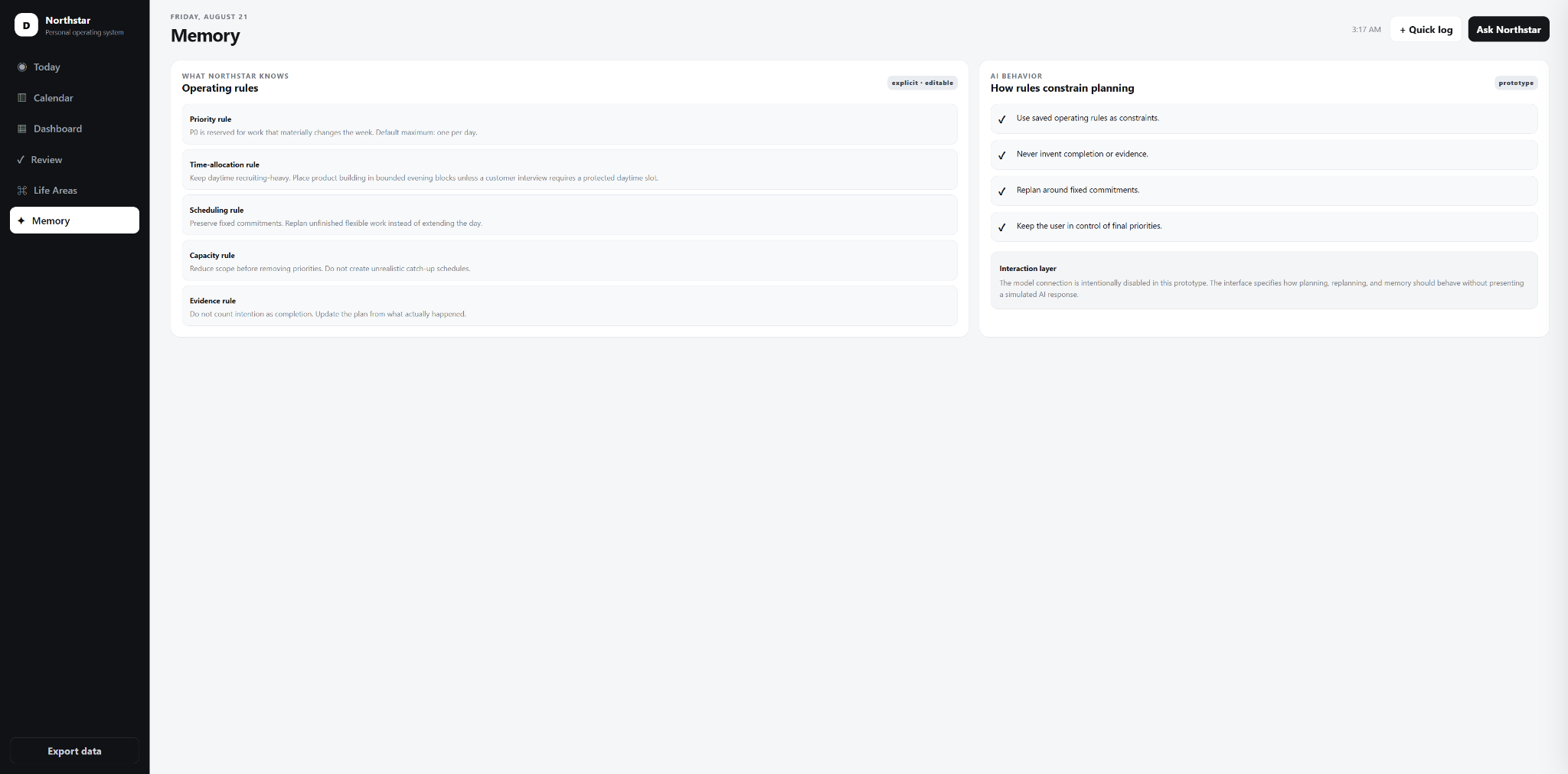
MEMORY

What should the system learn without taking control away from the user?

Northstar makes operating rules explicit and editable rather than hiding them inside a generic assistant. It distinguishes persistent rules, observed evidence, AI behavior, and final user judgment.

Persistent context · AI constraints · Evidence · User control
Northstar Memory prototype showing explicit operating rules and AI behavior constraints
TODAYDecide what deserves limited capacity.
DASHBOARDCompare the plan with what actually happened.
MEMORYCarry forward the rules that should change the next decision.

Plan → Act → Observe → Learn → Replan

WHAT I LEARNED BY BUILDING IT

Useful mechanics still need product evidence.

Daily utility and product scope are not the same question.

A behavior can be useful to me every day without proving that a standalone product needs to own the entire daily-planning stack.

Existing capability is not evidence of unmet demand.

Calendars, task managers, planning tools, and generic AI already solve substantial parts of the workflow. Integration alone is not differentiation.

Founder dogfooding is evidence, not validation.

Using the system myself exposed product mechanics worth testing. It does not prove that other people have the same problem or want the same solution.

STILL TESTINGGeneralizability · Beachhead user · Daily versus weekly wedge · Standalone value · Willingness to pay · Retention
Product discoveryDogfoodingPrioritizationProgram planningAI workflowsInteraction designCustomer discoveryDecision gatesIteration
TEND · CONSUMER AI PRODUCT

From remembered context to thoughtful action

Tend is an AI-assisted product for busy professionals who already know and care about their partner, but do not always have the planning bandwidth to turn that knowledge into a thoughtful gift, date, or small action.

Instead of asking the user to reconstruct their partner in every prompt, Tend explores whether structured partner memory can make those decisions more useful and more executable.

I took the concept from problem framing through structured research, product definition, high-fidelity interaction design, and an MVP build.

01 · FRAMERelationship execution, not relationship coaching.
02 · RESEARCHDemand, substitutes, feasibility, monetization, privacy, and validation.
03 · DEFINEPartner Memory + Gifts + Plans + Tend action surface.
04 · PROTOTYPETranslate the product logic into connected Figma interaction flows.
05 · BUILDMove the product definition into an MVP build.
PRODUCT SURFACES

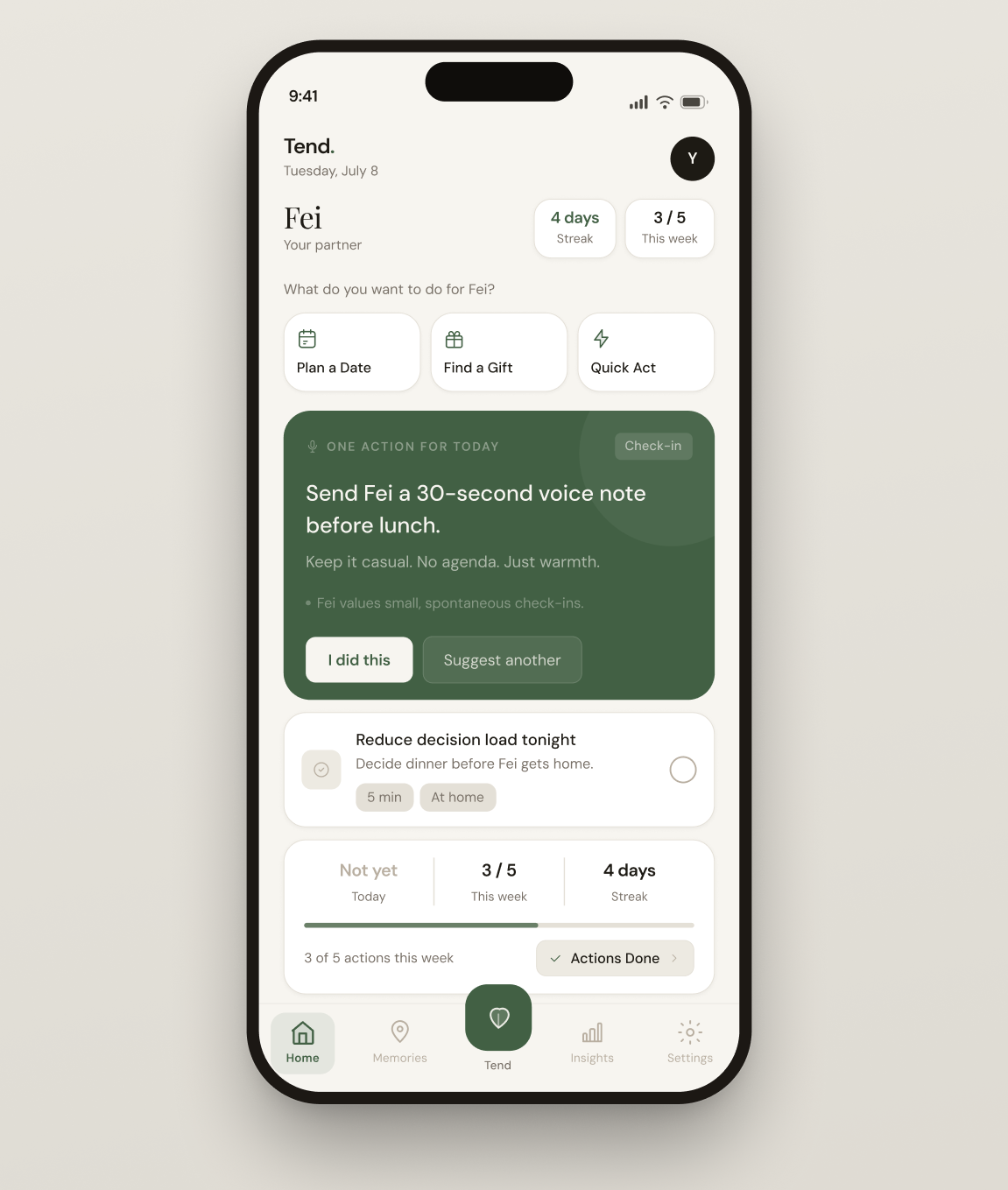
Home opens the Tend interaction. Partner Memory supplies its context.

HOME · ENTRY POINT

Keep the next thoughtful action close.

Home is intentionally lightweight: enough context to act without turning the relationship into another dashboard to manage.

It keeps the next useful action visible and provides the entry point into the core Tend interaction through the green Tend button.

Tend Home prototype showing a suggested action, weekly progress, and the central Tend button
Tap green Tend buttonOpens the core action surface
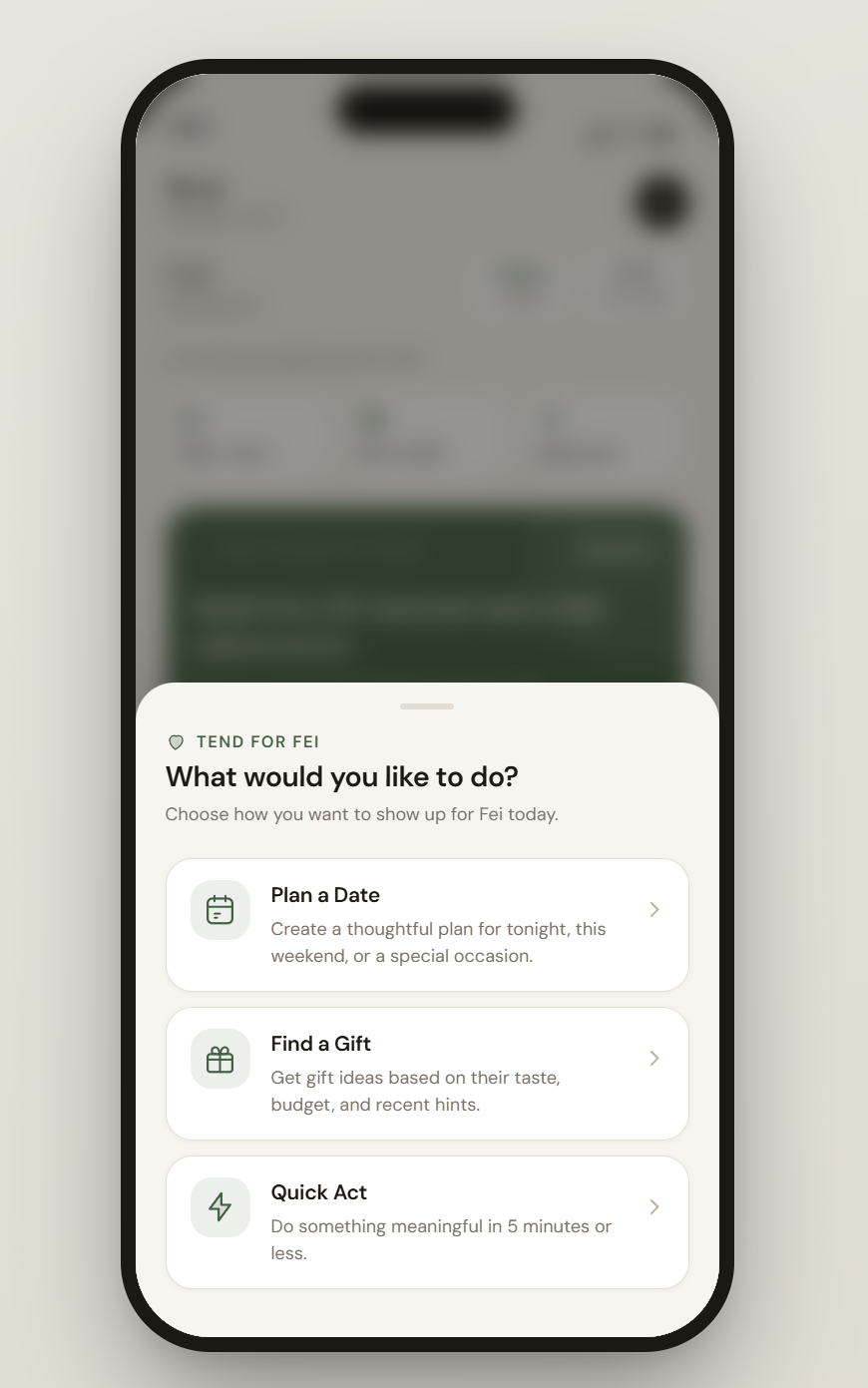
TEND FOR FEI · CORE INTERACTION

Turn partner context into a plan.

The core interaction uses remembered partner context to support AI-assisted date planning, gift discovery, and small thoughtful actions.

The product is not trying to help someone care more. It is designed to reduce the planning and decision load between knowing your partner and actually doing something thoughtful with what you know.

This is the core interaction represented in the current MVP / product build. It does not imply a live production AI backend.
Tend for Fei prototype with Plan a Date, Find a Gift, and Quick Act choices
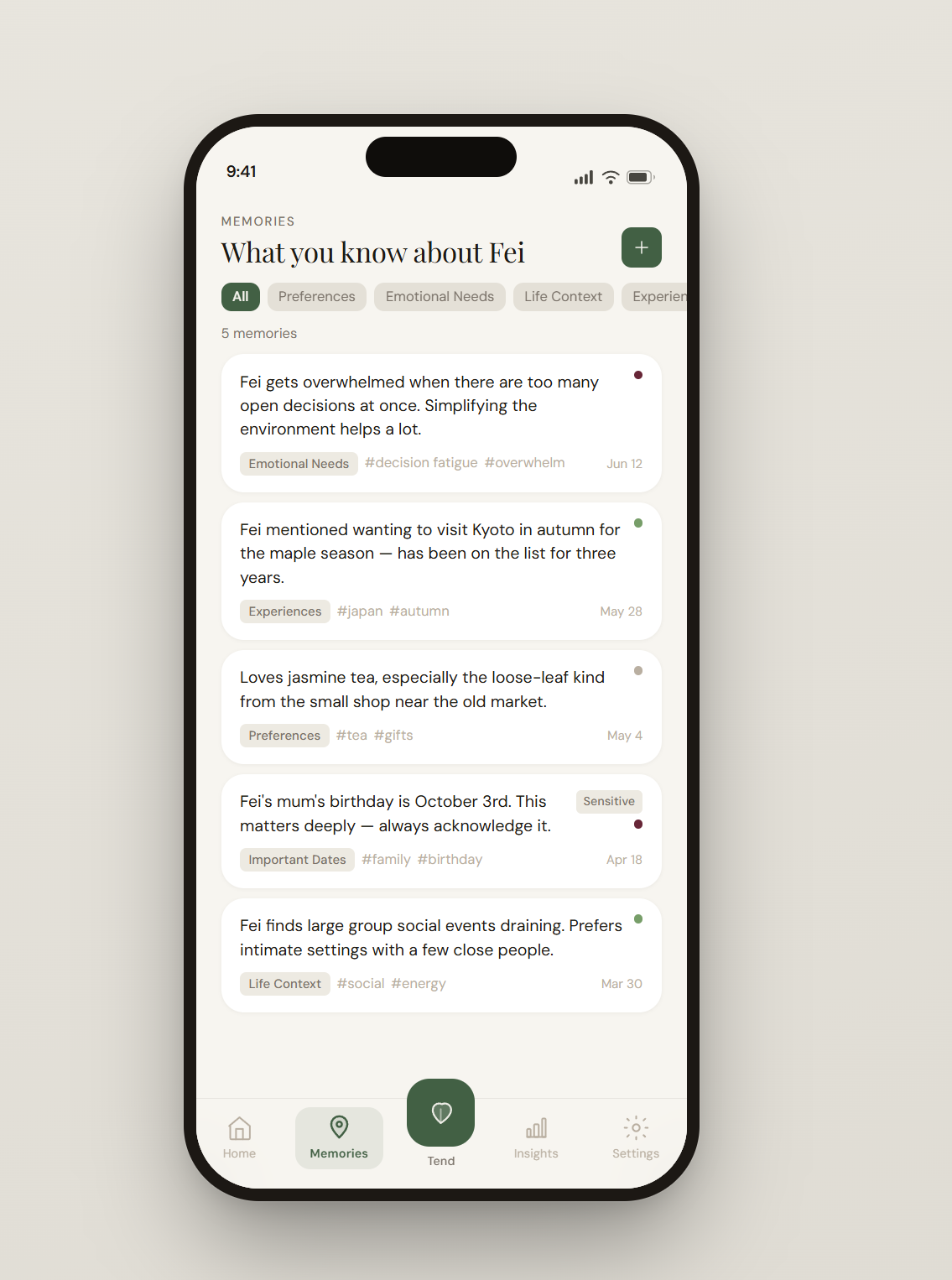
MEMORIES · CONTEXT LAYER

Persistent context, with boundaries.

Partner Memory organizes preferences, experiences, emotional needs, important dates, and other user-provided context so the user does not have to reconstruct their partner in every interaction.

Persistence itself is a product decision: what may be remembered, what may be inferred, what should require confirmation, and what should not become persistent memory at all.

Tend Memories prototype organizing partner context with a sensitive memory treatment
Partner MemorySupports the core Tend interaction
PRODUCT JUDGMENT

What the research changed

Generic AI is already a strong substitute.

Gift ideas, restaurant recommendations, and conversational brainstorming alone are not meaningful differentiation.

The product hypothesis moved toward structured context.

Reusable Partner Memory, native gift / plan objects, and partner-specific context became the core differentiation hypothesis.

External facts should stay verifiable.

AI can interpret intent, match context, rank options, and explain recommendations. Deterministic systems or trusted external sources should own prices, inventory, opening hours, routes, and URLs.

WHAT THE WORK DOES NOT PROVE

Beachhead segment · Differentiation versus generic AI · Willingness to pay · Retention
Problem framingResearch synthesisProduct definitionAI memoryInteraction designPrototypingProduct judgment

EXPERIENCE

Transaction training, then operating ownership.

NOV 2025 TO MAY 2026

AGS Health

Corporate Development Manager

First dedicated M&A hire at a Blackstone-backed healthcare services company. Built and operated the process behind screening, diligence, executive reporting, and integration planning.

JUL 2023 TO OCT 2024

Robert W. Baird

Investment Banking Analyst, Consumer

Consumer sell-side M&A across live processes from marketing and buyer outreach through diligence, management presentations, and closing.

DEC 2019 TO JUL 2021

Chase

Associate Banker

Client-facing consumer banking while completing Accounting and Finance degrees.

University of Rochester Simon Business School

UNIVERSITY OF ROCHESTER

Master of Science in Finance

Teaching Assistant, MBA Mergers & Acquisitions (FIN438)
University of Houston

UNIVERSITY OF HOUSTON

BBA Accounting · BBA Finance

Dual degree

CREDENTIALS

Passed FINRA Series 79 and SIEWall Street Prep Financial Modeling Certification

WORKING STYLE

The context changes. The operating principles do not.

01

Start with the problem, not the output.

A model, dashboard, workflow, meeting, or feature earns its place only if it changes a decision or a behavior.

02

Make ownership and dependencies visible.

Anyone inside the work should be able to tell what is moving, what is blocked, who owns the next action, and which decision is waiting on it.

03

Build something concrete enough to challenge.

I would rather expose a first version to criticism than spend longer perfecting assumptions in the abstract.

04

Treat friction as evidence.

When people work around a process, misunderstand it, or quietly stop using it, that is information about the design.

05

Separate what we know from what we want to be true.

Models, research, and AI can all produce confident-looking output. Assumptions should stay visible, and unsupported conclusions should stay out of the decision.

HOW I THINK ABOUT AI

I use AI to shorten the distance between a question and something concrete enough to inspect, challenge, and improve.

The most interesting design question is often not what a model can generate. It is what the system should know, what it should remember, what it may infer, what requires confirmation, and where final judgment should remain human.

GET IN TOUCH

Build something useful.

I build products and AI-assisted workflows around problems I want to understand better, from noticing the problem and researching it through to getting something working. I am most useful where the problem is still being defined.